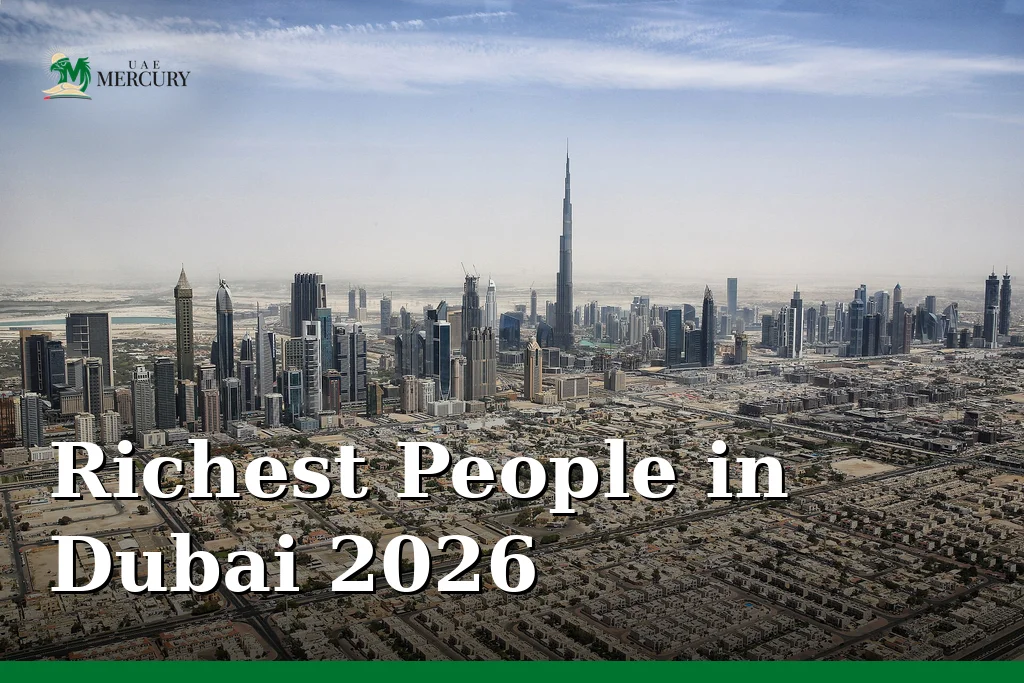
Most people read a billionaire ranking as a celebrity list: names, numbers, a photograph of a tower. Dubai's ranking rewards a different reading. Spread the eight names on the 2026 Forbes list out on a table and they stop looking like a rich list and start looking like an economic map — six industries, each of which grew because Dubai itself grew. The richest people in Dubai did not mostly inherit their money or strike oil. They sold the city its homes, its groceries, its schools, its hospitals, its building sites and, in one case, its favourite messaging app. Together the eight are worth about $42.5 billion. The figures below are Forbes estimates as of 1 March 2026.
Property: The Landlords at the Top
The largest fortune on the list is a property fortune, and so is the sixth. Hussain Sajwani, at $15.3 billion, founded DAMAC Properties in 2002 after starting out in catering in 1982, took the company private again in 2022, and has since pushed into data centres, fashion and hospitality alongside the branded towers and lagoon communities he is known for. The full arc of that career is worth its own read in this Hussain Sajwani net worth guide. Mohamed Alabbar, at $3.2 billion, built Emaar — the developer behind the Burj Khalifa and Dubai Mall — and also chairs Americana Restaurants and founded the e-commerce platform Noon. Between them, the two property names account for roughly $18.5 billion, close to half the list's combined wealth. In a city that has spent four decades converting desert into districts, that should surprise no one: land is the original Dubai business.
Technology: One Man, One App
Second place belongs to the list's only pure technology fortune. Pavel Durov, at $6.6 billion, co-founded VKontakte in Russia before leaving in 2014 and building Telegram with his brother Nikolai. He has lived in Dubai since 2017, Telegram is headquartered there, and he became a UAE citizen in 2021. His presence on a Dubai list is itself an industry statement: the city's second-largest fortune was not made in Dubai at all, but was moved here — drawn by the same tax, safety and residency offer that now attracts founders from everywhere. Technology contributes just one name, but it is the name that best explains where the next decade of arrivals may come from. Note, too, what Durov's fortune is not: it is not a stake in a local monopoly or a government contract. Telegram's users are global, its revenue is global, and only its headquarters sits in Dubai — a template that software, fintech and AI founders can copy far more easily than a hospital chain or a supermarket group ever could.
Retail and Construction: The Kerala Corridor
The third and fourth fortunes came up the oldest trade route of all, from Kerala to the Gulf. M.A. Yusuff Ali, at $5.8 billion, turned LuLu into one of the region's dominant supermarket groups — a business that monetises the everyday spending of millions of residents rather than the luxury spending of a few. Ravi Pillai, at $4.1 billion, built the RP Group from a farming-family background into a construction giant that helped physically build the Gulf's expansion. Retail and construction are unglamorous industries, and that is precisely the point: both fortunes rest on volume — food bought daily, buildings raised constantly — in a region whose population kept growing for forty years.
Education and Healthcare: Selling Certainty to Families
The bottom half of the list is dominated by two industries that expatriate families cannot opt out of. Sunny Varkey, at $4.0 billion, grew GEMS Education from a single school into a global group; in a city where most residents are expatriates and schooling is private, education is a subscription the whole population pays. Healthcare follows the same logic. Azad Moopen, at $1.8 billion, built Aster DM Healthcare from a single clinic, and Shamsheer Vayalil, at $1.7 billion, built Burjeel Holdings into one of the UAE's largest hospital operators. Both men trained as doctors before they became billionaires. Schools and hospitals are the infrastructure of settled family life — and their presence on the list is a sign of how far Dubai has moved from a bachelor-worker economy to a family one. It is also worth noting the pattern inside the pattern: Varkey's schools and the two hospital groups sell to the same customer — the resident family that plans to stay for a decade, not a contract season. Every long-term residency reform the UAE introduces, from golden visas to family sponsorship changes, quietly enlarges the market these three fortunes depend on. Their wealth is, in effect, indexed to how permanent Dubai's population becomes.
What the Mix Tells You About Dubai
Three things stand out from the industry map. First, there is no oil fortune on this list: every dirham traces back to services, trade or property sold to a growing population. Second, the fortunes are unusually operational — these are founders who still run supermarkets, schools, hospitals and developers, not passive investors. Third, five of the eight were born in Kerala, which says as much about migration as about money: Dubai's rich list is what forty years of open labour and trade routes look like when compounded. Read this way, the 2026 ranking is not really about eight men. It is a balance sheet of the city itself — and the industries on it are the ones that will decide what the 2030 list looks like.
One final caveat belongs with any Dubai wealth discussion: Forbes counts business fortunes, not ruling families, so the list describes the city's commercial class rather than its total wealth. That distinction matters less than it used to. A generation ago, a Gulf rich list without royal or oil money would have been almost empty. Dubai's 2026 list, built from towers, trolleys, classrooms and hospital wards, shows how completely that has changed — the merchants now out-earn the stereotype.